The Ultimate Guide to Carrot Cake in Singapore: A Hawker Food Lover's Journey
Unravelling the Magic of Singapore's Carrot Cake (Chai Tow Kway)
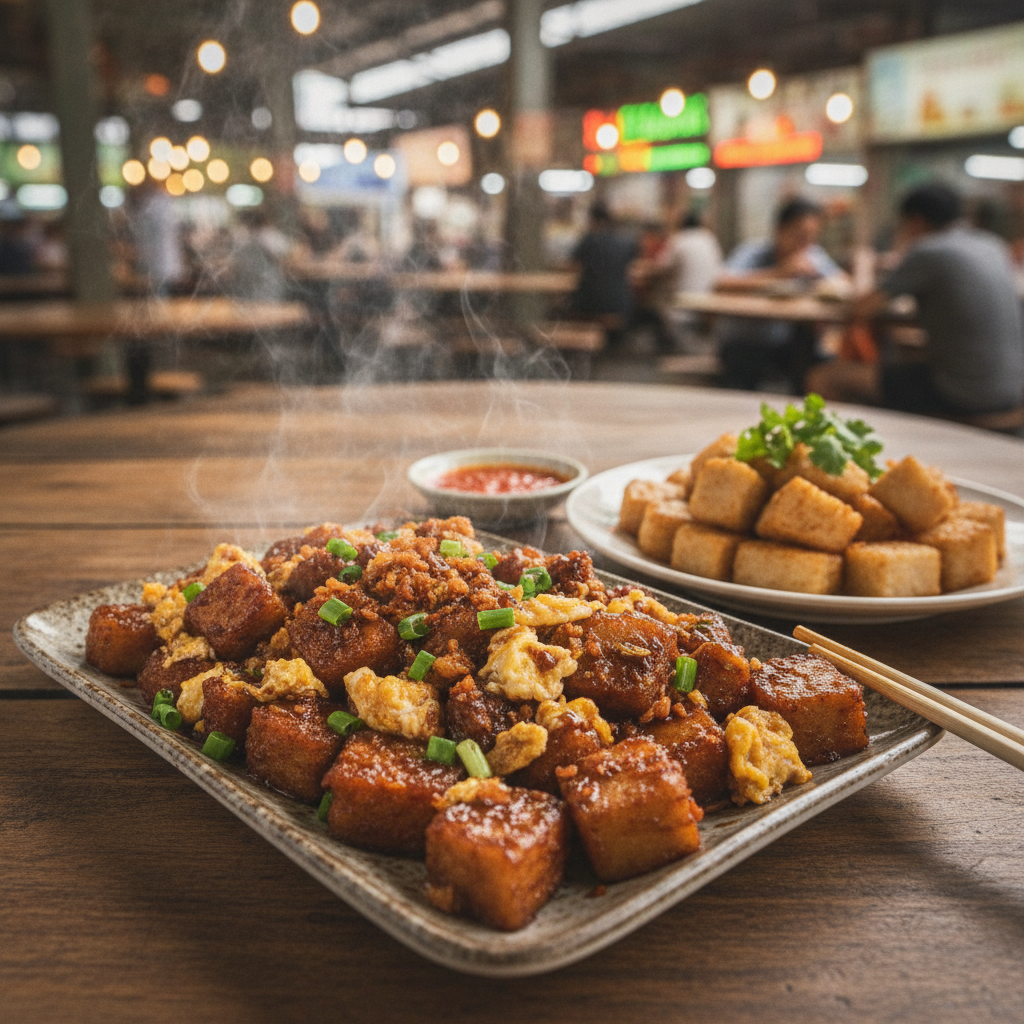
Ask any Singaporean about their favourite hawker dish, and chances are, 'carrot cake' will pop up with enthusiastic nods. But hold your horses – if you're expecting a sweet, cream-cheese topped dessert, prepare for a delicious surprise! In Singapore, 'carrot cake' (or its Hokkien/Teochew name, Chai Tow Kway) is a savoury, stir-fried radish cake dish that's a cornerstone of our culinary heritage. It’s a symphony of textures and flavours, from crispy fried bits to soft, steamed radish cake, all wok-fried to perfection. As your resident Singapore food blogger, I'm here to take you on a deep dive into this beloved dish. By the end of this ultimate guide, you'll be able to confidently navigate hawker centres, order like a pro, and savour every single crumb of Singapore's iconic Chai Tow Kway – whether you're a first-time visitor or a seasoned local looking for new insights!
A Taste of History: The Roots of Chai Tow Kway
The origins of Chai Tow Kway can be traced back to the Teochew immigrants from Chaoshan, China. This humble dish was born out of ingenuity, using leftover steamed radish cake (chai tow kway in Teochew literally means 'fried radish cake') stir-fried with eggs, garlic, and preserved radish (chai poh). It was a simple, hearty meal, often consumed for breakfast or as a snack.
Over the decades, as the dish made its way to Singapore, it evolved to suit local palates. The most significant divergence came with the introduction of 'black' carrot cake, a uniquely Singaporean twist that incorporates sweet dark soy sauce, caramelising the dish and adding a delightful sweetness to its savoury base. This innovation cemented its place as a versatile dish, enjoyed at any time of day. Crucially, the 'carrot' in its English name is a misnomer; the main ingredient is white radish (daikon), not the orange carrot we typically associate with 'carrot cake' desserts. It's a delightful linguistic quirk that often stumps tourists, making the first encounter with our carrot cake all the more memorable!
The Two Faces of Carrot Cake: White vs. Black and Beyond
Where to Find the Best Carrot Cake in Singapore
The beauty of carrot cake is its ubiquity – you'll find a stall in almost every hawker centre! But for truly exceptional plates, here are some legendary spots you absolutely must try:
* **Lau Goh Teochew Choon Kee (Zion Riverside Food Centre):** A truly iconic stall, famous for both its white and black versions, with a generous amount of fragrant chai poh. Be prepared for a queue, but it's worth it for a taste of history. * **Ghim Moh Chwee Kueh (Ghim Moh Market & Food Centre):** While renowned for chwee kueh, their carrot cake often gets rave reviews for its crispy texture and fragrant wok hei. They do both white and black equally well. * **Bukit Merah Central Carrot Cake (Bukit Merah Central Food Centre):** Known for its incredibly fluffy radish cake and perfectly charred crispy edges. Their black carrot cake is particularly lauded for its rich, sweet-savoury balance. * **Fu Ming Cooked Food (Redhill Food Centre):** This spot is a local favourite for its consistent quality and hearty portions. Their black carrot cake is a standout, boasting a deep, caramelised flavour. * **He Zhong Carrot Cake (Ang Mo Kio Ave 4):** A no-frills stall focusing on the classic white carrot cake, known for its generous use of egg and a wonderfully chewy texture. A great spot for purists.
Ordering Like a Pro: Tips & Etiquette
Navigating a bustling hawker centre can be daunting, but ordering carrot cake is usually straightforward. Here's how to do it right:
1. **Specify Your Colour:** The most important decision! Clearly state 'White Carrot Cake' (白萝卜糕, bái luó bo gāo) or 'Black Carrot Cake' (黑萝卜糕, hēi luó bo gāo). 2. **Choose Your Size:** Most stalls offer small, medium, and large portions. Simply say 'small' (小, xiǎo), 'medium' (中, zhōng), or 'large' (大, dà). 3. **Chilli Level:** If you like it spicy, ask for 'with chilli' (加辣椒, jiā là jiāo). If you prefer a milder kick, 'less chilli' (少辣椒, shǎo là jiāo). If you don't want any spice, 'no chilli' (不要辣椒, bù yào là jiāo). 4. **Special Requests (if available):** Some stalls might allow 'extra egg' (加蛋, jiā dàn) or 'extra chai poh' (加菜脯, jiā cài pú). It never hurts to ask politely. 5. **Payment:** Most hawker stalls are cash-only, so have some small notes ready. Some newer ones might accept e-payments (PayLah, PayNow). 6. **Be Patient:** Especially at popular stalls, there will be a wait. The chef is typically cooking multiple orders at once, often to perfect that wok hei. Find a table, come back when your number is called or your order is ready.
What to Expect: Price Guide
One of the joys of hawker food is its affordability! Carrot cake is no exception. You can expect to pay:
* **Small portion:** S$3.00 - S$4.00 * **Medium portion:** S$4.00 - S$5.50 * **Large portion:** S$5.00 - S$7.00
Prices can vary slightly depending on the stall's popularity, location (e.g., city centre vs. heartlands), and whether you request any premium add-ons like prawns. Even at the higher end, it remains an incredibly value-for-money meal.
Don't Be a Newbie! Common Mistakes to Avoid
To ensure your carrot cake experience is nothing short of perfect, steer clear of these common pitfalls:
1. **Calling it a Dessert:** This is the cardinal sin! Remember, Singapore's carrot cake is a savoury dish, not a sweet treat. You'll get a confused (or perhaps amused) look from locals. 2. **Expecting a Uniform Texture:** Chai Tow Kway is a medley! It's meant to have soft, chewy bits, slightly crispy edges, and eggy goodness. Don't expect a single, homogenous texture. 3. **Only Trying One Type:** You *must* try both white and black! They offer distinctly different flavour profiles, and both are essential experiences. 4. **Being Impatient:** Good food takes time, especially when cooked to order with proper wok hei. Rushing the hawker will only lead to a less-than-perfect dish. 5. **Ignoring the Chai Poh:** Those tiny, crunchy, salty bits of preserved radish are crucial to the flavour! Don't pick them out – they add an essential layer of umami.
Insider Secrets from a Local Foodie
Want to elevate your carrot cake game? Here are some pro tips:
* **Look for 'Wok Hei':** The true hallmark of excellent carrot cake is the smoky, charred aroma and flavour imparted by a fiercely hot wok. You'll often see the chef tossing the ingredients high in the air – that's the magic happening! * **Ask for 'Extra Crispy' (if possible):** Some stalls can accommodate requests for 'extra crispy' bits (more fried radish cake), enhancing that delightful texture contrast. Don't be afraid to ask politely. * **Pair it Right:** Carrot cake makes a fantastic breakfast, but it also shines as a side dish to other hawker delights like oyster omelette or char kway teow for a full culinary spread. * **Observe the Chef:** A good carrot cake chef is often a master of timing and flame control. Watch how they work the wok – it's part of the show and tells you a lot about the quality you're about to receive. * **Don't Be Afraid of the Oil:** Yes, it can look a bit oily, but that's part of the flavour and the frying process that creates the texture. It's a treat, not an everyday health food!
❓ Frequently Asked Questions
🎯 Final Thoughts
From its humble Teochew origins to its status as a beloved national dish, Singapore's carrot cake is more than just fried radish cake – it's a testament to our culinary ingenuity and the vibrant spirit of our hawker culture. Whether you prefer the classic savoury crispness of the white version or the sticky, sweet-savoury allure of the black, each plate offers a unique and satisfying experience.
Now armed with this ultimate guide, you're ready to embark on your own Chai Tow Kway adventure. Don't just eat it; savour the history, appreciate the skill of the hawker, and revel in the symphony of flavours. So go forth, explore our hawker centres, and find *your* perfect plate of carrot cake. And when you do, don't forget to share your delicious discoveries with me!