The Ultimate Guide to Hokkien Mee in Singapore: A Culinary Deep Dive
Introduction: Wok Hei Wonders and Noodle Nirvana
Ah, Hokkien Mee! Just the mention of it sends a ripple of savoury anticipation through any true Singaporean food lover. It's more than just a plate of stir-fried noodles; it's a symphony of textures and flavours, a testament to humble hawker artistry, and an essential pillar of our diverse culinary landscape. If you've ever found yourself captivated by the smoky aroma wafting from a hawker stall, wondering about the perfect balance of prawns, squid, pork, and those distinctive noodles bathed in rich prawn broth, then you've come to the right place.
In this ultimate guide, your resident Singapore food blogger will take you on an exhaustive journey through the world of Hokkien Mee. We'll delve into its fascinating history, identify the key components that make it sing, reveal the legendary stalls where you can find the very best, arm you with ordering tips, help you avoid common pitfalls, and share insider secrets that even some locals might not know. Get ready to slurp your way to Hokkien Mee enlightenment!
A Taste of History: The Humble Beginnings of a Hawker Classic
Like many of Singapore's iconic hawker dishes, Hokkien Mee boasts a rich, working-class heritage. Its origins can be traced back to post-World War II Singapore, specifically to the Hokkien immigrants from Fujian province in China. Legend has it that these intrepid workers, often operating noodle factories, would gather leftover noodles and stir-fry them with available scraps of pork, seafood, and a flavourful prawn-based broth.
Initially, this was a pragmatic, hearty meal designed to sustain hardworking labourers. Over time, as Singapore prospered, so too did Hokkien Mee. What started as a simple stir-fry evolved, with hawkers perfecting the 'wok hei' (the breath of the wok – a smoky, caramelised flavour imparted by high heat) and refining the prawn broth, which is now the soul of the dish. The characteristic combination of thick yellow noodles and thin white bee hoon (vermicelli), bathed in a luscious, savoury gravy, became the quintessential Singaporean Hokkien Mee – a distinct departure from its drier, darker Malaysian counterparts. It's a dish that tells a story of ingenuity, adaptation, and culinary evolution.
The Anatomy of a Perfect Plate: What Makes Singapore Hokkien Mee Shine
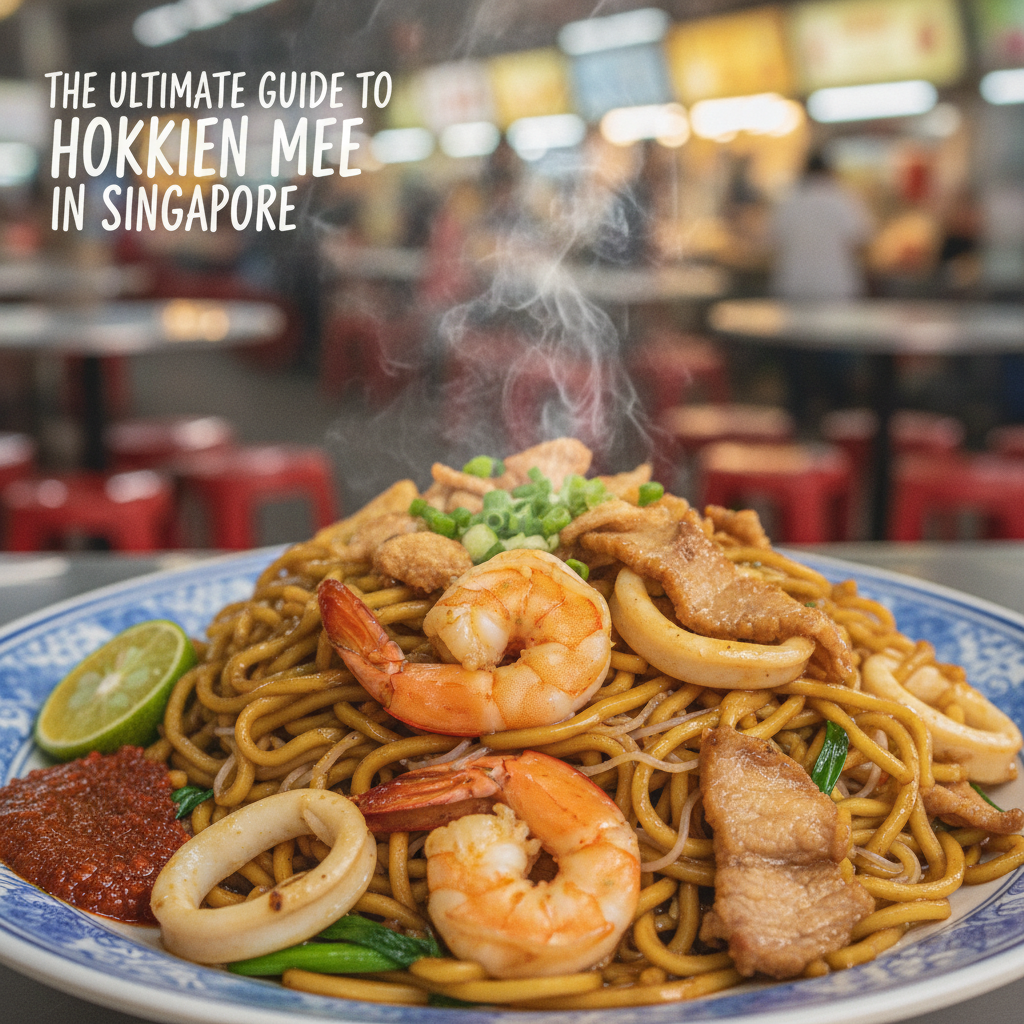
Singaporean Hokkien Mee is a marvel of balance, texture, and deep umami. Here’s what you should expect and appreciate in every plate:
* **The Noodles:** The defining characteristic is the harmonious blend of thick, round yellow noodles and thin white bee hoon (rice vermicelli). The yellow noodles provide chewiness and absorb the broth beautifully, while the bee hoon offers a contrasting delicate texture and soaks up all the flavour. * **The Broth:** This is the heart and soul! A rich, intensely flavourful prawn stock, often simmered for hours with prawn heads, pork bones, and other secret ingredients. It's what gives the noodles their signature moistness and depth of flavour. * **The Seafood:** Fresh prawns and tender slices of squid (sotong) are non-negotiable. They lend sweetness and a delicate chew, infusing the broth with their oceanic essence. * **The Pork:** Sliced pork belly, often marinated, adds a savoury richness and a satisfying bite, complementing the seafood. * **The Vegetables:** Bean sprouts and chives provide a crucial crunch and a hint of freshness, cutting through the richness. * **The Wok Hei:** That elusive, smoky aroma and taste imparted by cooking over intensely high heat in a seasoned wok. It's the hallmark of a truly skilled Hokkien Mee master. * **The Condiments (Crucial!): * **Sambal Chilli:** A fiery, tangy, often belacan-infused chilli paste that adds a vital kick and complexity. Mix it in gradually to your preferred spice level. * **Pork Lard Croutons:** Small, crispy cubes of deep-fried pork fat. These are pure flavour bombs, adding an irresistible crunch and richness. Don't skip them unless you absolutely must! * **Lime:** A squeeze of fresh lime juice brightens the entire dish, adding a zesty counterpoint to the savoury richness and enhancing the seafood notes.
Where to Find Your Next Hokkien Mee Fix: Legendary Stalls Across the Island
Singapore is blessed with numerous Hokkien Mee masters, each with their own loyal following. Here are some of the titans you absolutely must try:
* **Geylang Lor 29 Fried Hokkien Mee (East):** Often cited as one of the best, this stall is famous for its incredibly flavourful, wetter style Hokkien Mee with a generous amount of seafood and a robust prawn broth. Expect a queue, but it moves fast! * *Address: 399/401 Geylang Rd, Singapore 389385* * **Come Daily Fried Hokkien Prawn Mee (Central/North):** A consistent crowd-pleaser known for its generous portions, intense wok hei, and consistently excellent chilli. They also offer a slightly drier style compared to Lor 29, but still distinctly Singaporean. * *Address: Blk 127 Lorong 1 Toa Payoh, Toa Payoh West Market & Food Centre, #02-27, Singapore 310127* * **Nam Sing Hokkien Fried Prawn Mee (East):** This stall at Old Airport Road Food Centre is an institution, known for its unique, slightly drier, and very savoury version. They don't use pork lard and have a distinct chilli, making it a must-try for comparison. * *Address: 51 Old Airport Rd, Old Airport Road Food Centre, #01-32, Singapore 390051* * **Eng Ho Fried Hokkien Prawn Mee (West):** Tucked away in Commonwealth Crescent Market, Eng Ho delivers a deeply satisfying plate with strong wok hei and a slightly wetter consistency. A true hidden gem for those in the west. * *Address: 31 Commonwealth Cres, Commonwealth Crescent Market, #02-73, Singapore 149644* * **Hong Heng Fried Sotong Prawn Mee (Central):** Located in the ever-popular Tiong Bahru Market, Hong Heng is another award-winning stall (Michelin Bib Gourmand recipient!). Their Hokkien Mee is perfectly balanced, with fantastic wok hei and tender squid. * *Address: 30 Seng Poh Rd, Tiong Bahru Market, #02-01, Singapore 168898*
Ordering Like a Pro: Tips and Hawker Etiquette
Navigating a busy hawker centre can be daunting, but ordering Hokkien Mee is straightforward with these tips:
* **Join the Queue:** For popular stalls, a queue is a sign of good food. Respect it and wait your turn patiently. * **State Your Order Clearly:** Most stalls offer different sizes (e.g., Small, Medium, Large, or by price point like $5, $8, $10). Specify your preferred size. * **Customization (Limited):** You can often request 'less chilli' or 'no chilli' for the sambal. Asking for 'no pork lard' is also common. However, major alterations (e.g., 'no prawns, extra squid') might not always be accommodated, especially during peak hours. * **'Take Away' or 'Dine In':** Make it clear if you're eating there ('eat here' or 'dine in') or taking away ('tapau' or 'take away'). For take away, they'll pack the lime and chilli separately. * **Payment:** Cash is king at many hawker stalls, though increasingly, e-payment options are available. Have small notes ready. * **Table Etiquette:** If you're dining in, especially during peak hours, be prepared to share tables. If you see tissue packets or an umbrella on a table, it usually means it's 'choped' (reserved). Don't remove it unless you want some serious side-eye!
Price Expectations: A Delicious Bargain
One of the beautiful things about hawker food in Singapore is its affordability, and Hokkien Mee is no exception. You can expect to pay:
* **Small Plate:** S$5.00 - S$7.00 * **Medium Plate:** S$7.00 - S$10.00 * **Large Plate:** S$10.00 - S$15.00 (often sufficient for 2 hungry individuals or one very hungry person!)
Prices may vary slightly depending on the stall's popularity, location, and the generosity of ingredients. Even at the higher end, it remains an incredibly satisfying and value-for-money meal.
Common Mistakes to Avoid for the Best Experience
Don't let these minor missteps dampen your Hokkien Mee adventure:
* **Skipping the Condiments:** Not mixing in the sambal or, worse, forgetting to squeeze that vital lime, is a rookie error. These elements are integral to the dish's balance. * **Expecting Malaysian-Style:** Singaporean Hokkien Mee is typically wetter, lighter in colour, and primarily uses thick yellow noodles with thin bee hoon, bathed in prawn broth. The Malaysian version (particularly KL Hokkien Mee) is drier, much darker from dark soy sauce, and often only uses thick yellow noodles. Appreciate each for what it is! * **Being Impatient:** Good food takes time. Hawkers are often cooking large batches over intense heat. Be patient, especially during peak lunch or dinner hours. * **Not Observing the Wok Hei:** A great plate of Hokkien Mee should have that distinct, slightly charred, smoky aroma. If it's missing, you might have picked the wrong stall (or a bad day for a good one). * **Ordering 'No Pork Lard' unnecessarily:** Unless you have dietary restrictions, the pork lard croutons are a flavour enhancer that truly elevates the dish. Don't deprive yourself!
Insider Tips from a Singapore Foodie
Want to eat Hokkien Mee like a true local connoisseur? Here's the lowdown:
* **Watch the Queue (But Not Always):** A long queue is *usually* a good indicator, but not every legendary stall has one at all times. Some excellent stalls have more consistent, manageable lines. * **Observe the Cook:** A skilled Hokkien Mee hawker will be vigorously tossing and stirring the noodles, ensuring even coating and allowing the 'wok hei' to develop. Look for the flames licking the wok! * **Ask for Extra Chilli/Lime (Politely):** If you're a spice fiend or a lime lover, don't be shy to ask for extra sambal or another lime wedge. Most hawkers are happy to oblige (sometimes for a small extra charge). * **Go During Off-Peak Hours:** If you want to avoid the longest queues and potentially get a more attentive cook, aim for late mornings or mid-afternoons. * **Try Different Stalls:** Even among the 'best', each stall has its unique nuances – some are wetter, some drier, some spicier. Experiment to find *your* favourite style. * **Pair with a Sugarcane Juice:** The sweetness and coolness of freshly pressed sugarcane juice (or a refreshing lime juice) perfectly complement the rich, savoury, and sometimes spicy Hokkien Mee.
Frequently Asked Questions About Hokkien Mee
Let's clear up some common queries:
* **Q: What is 'wok hei'?** * A: 'Wok hei' literally translates to 'the breath of the wok'. It's a highly prized, smoky, charred aroma and flavour imparted to food cooked in a wok over intense heat. It's a sign of a skilled hawker and is crucial for authentic Hokkien Mee. * **Q: Is Singaporean Hokkien Mee spicy?** * A: The noodles themselves are not inherently spicy. The spice comes from the accompanying sambal chilli. You can control the spice level by adding as little or as much sambal as you like, or even requesting no chilli at all. * **Q: Can I get Hokkien Mee without seafood or pork?** * A: It's extremely difficult, as both seafood (prawns, squid, prawn broth) and pork (pork belly, pork lard) are fundamental to the dish's flavour profile. It's not typically a vegetarian or halal-friendly dish. * **Q: What's the difference between Singaporean and Malaysian Hokkien Mee?** * A: Singaporean Hokkien Mee is generally wetter, lighter in colour, and uses a mix of yellow noodles and bee hoon, with a dominant prawn broth flavour. Malaysian (specifically KL) Hokkien Mee is typically drier, much darker (from dark soy sauce), and often uses only thick yellow noodles, with a stronger savoury, almost burnt flavour profile. * **Q: Is Hokkien Mee a healthy dish?** * A: Let's be honest, with its rich broth, pork lard, and stir-fried noodles, Hokkien Mee is a delicious indulgence rather than a health food. It's best enjoyed in moderation as a treat!
Conclusion: Your Hokkien Mee Journey Begins Now!
From its humble beginnings to its current status as a national treasure, Hokkien Mee is a dish that truly embodies the spirit of Singapore's hawker culture. It's a testament to simple ingredients transformed into something extraordinary through skill, passion, and time-honoured techniques.
Whether you're a curious tourist eager to dive into local flavours or a seasoned local looking to rediscover a beloved classic, this guide has equipped you with everything you need to embark on your own Hokkien Mee adventure. So, go forth, brave the queues, savour the wok hei, mix that sambal, squeeze that lime, and discover your personal favourite plate of these glorious, gravy-laden noodles. Your taste buds will thank you!