The Ultimate Guide to Hainanese Chicken Rice in Singapore: A Foodie's Essential Handbook
Introduction: Your Culinary Journey Begins
Selamat datang, foodies! If there's one dish that truly defines Singapore's culinary landscape, it's the humble yet magnificent Hainanese Chicken Rice. More than just a meal, it's a cultural icon, a source of national pride, and a flavourful legacy passed down through generations. From its fragrant rice to the perfectly poached chicken and the indispensable potent chili, every element tells a story.
In this ultimate guide, we'll peel back the layers of this beloved dish, arming you with everything you need to know: its fascinating origins, what makes a plate truly exceptional, where to find the best renditions across the island, how to order like a seasoned local, and insider tips to elevate your chicken rice experience. Whether you're a first-time visitor or a long-time resident, prepare to embark on a delicious journey into the heart of Singaporean cuisine.
A Taste of History: The Origins of Singapore's National Dish
Hainanese Chicken Rice traces its roots back to Wenchang chicken from Hainan Island, a southern province of China. Emigrants from Hainan brought their culinary traditions with them to Southeast Asia, particularly to Malaya (now Malaysia) and Singapore, adapting the dish to local palates and available ingredients.
While the original Wenchang chicken uses a specific breed of chicken and is served with an oily rice and various sauces, the Singaporean version evolved into its own distinct identity. Early Hainanese immigrants, often working as chefs or domestic helpers, refined the dish, poaching the chicken in a rich broth, infusing the rice with that same flavourful stock, and developing the trio of essential dipping sauces – chili, ginger, and dark soy. This adaptation cemented its place as a staple, transitioning from simple hawker fare to a celebrated national dish, beloved by all segments of society.
The Anatomy of Perfection: Key Components of Hainanese Chicken Rice
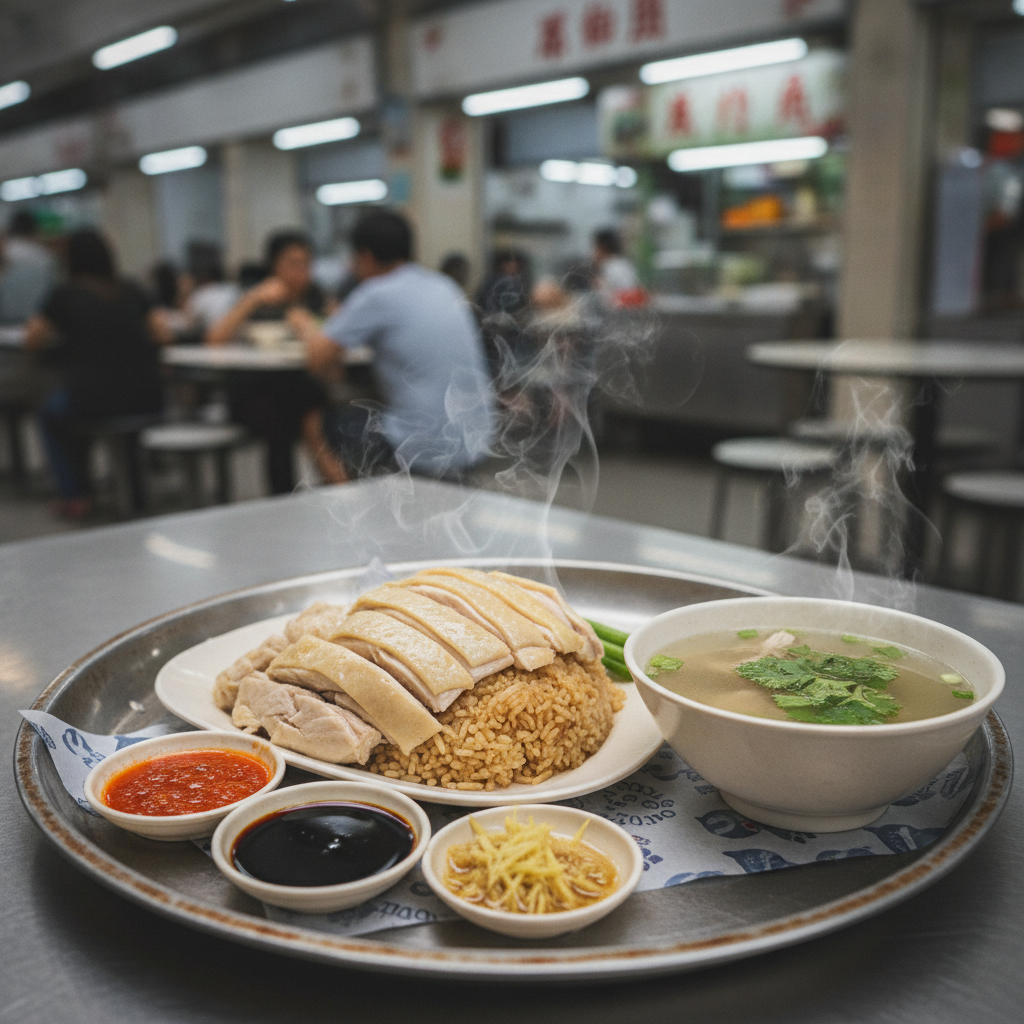
A truly great plate of Hainanese Chicken Rice is a symphony of flavours and textures. Here are the essential components to savour:
1. **The Chicken (鸡肉 - Jī Ròu):** * **Poached (白斩鸡 - Bái Zhǎn Jī / White Chicken):** The traditional and arguably most iconic style. Chicken is gently simmered in a flavourful broth until just cooked, then immediately plunged into an ice bath. This process yields incredibly tender, silky-smooth meat with gelatinous skin. The subtle flavour of the chicken shines through. It's often drizzled with a light soy sauce dressing. * **Roasted (烧鸡 - Shāo Jī / Roasted Chicken):** A popular alternative, though not traditionally Hainanese. The chicken is marinated and roasted or sometimes deep-fried, resulting in crispy, flavourful skin and juicy meat. Many stalls offer both, allowing you to mix and match.
2. **The Rice (饭 - Fàn):** This is arguably the *most* critical component. Long-grain rice is cooked in rich chicken broth, often with ginger, garlic, and pandan leaves. The result is fragrant, slightly oily, and incredibly flavourful rice, with individual grains that are firm yet tender. A good plate of chicken rice can be judged almost solely on the quality of its rice.
3. **The Chili Sauce (辣椒酱 - Là Jiāo Jiàng):** Non-negotiable! Singaporean chicken rice chili is a vibrant, potent concoction, typically made with red chilies, garlic, ginger, lime juice, and sometimes a splash of vinegar or chicken stock. It should be tangy, spicy, and slightly sweet, cutting through the richness of the chicken and rice.
4. **The Ginger Paste (姜蓉 - Jiāng Róng):** A fragrant accompaniment, usually a finely grated ginger paste mixed with spring onion and a dash of oil. It adds a sharp, aromatic counterpoint that enhances the chicken's flavour.
5. **Dark Soy Sauce (黑酱油 - Hēi Jiàng Yóu):** A thick, sweet, and savoury dark soy sauce, often drizzled sparingly over the chicken or used as a dipping sauce. It adds a layer of depth and umami.
6. **Clear Soup (清汤 - Qīng Tāng):** A light, savoury broth, often served on the side, made from the same stock used to cook the chicken and rice. It serves as a palate cleanser and a comforting addition.
Where to Find Them: Singapore's Top Chicken Rice Haunts
Singapore boasts countless chicken rice stalls, each with its loyal following. Here are some legendary spots and highly-regarded eateries, from hawker gems to established restaurants:
* **Tian Tian Hainanese Chicken Rice (天天海南鸡饭)** * **Location:** Maxwell Food Centre, 1 Kadayanallur St, Singapore 069184 * **Why it's famous:** Michelin Bib Gourmand recipient, known for its incredibly flavourful, moist rice and tender chicken. Expect long queues, but it's worth the wait for many.
* **Ah Tai Hainanese Chicken Rice (阿仔海南鸡饭)** * **Location:** Maxwell Food Centre, 1 Kadayanallur St, Singapore 069184 (just a few stalls away from Tian Tian) * **Why it's famous:** Run by a former head chef of Tian Tian, Ah Tai offers a very similar, yet distinct, style of chicken rice. Many locals swear by it as the 'original' or even superior version.
* **Boon Tong Kee (文东记)** * **Location:** Multiple outlets, flagship at 401 Balestier Rd, Singapore 329803 * **Why it's famous:** An institution since 1979, Boon Tong Kee provides a more restaurant-style dining experience. Known for their consistently good chicken and a wider menu beyond just chicken rice.
* **Tiong Bahru Hainanese Boneless Chicken Rice (中峇鲁海南起骨鸡饭)** * **Location:** Tiong Bahru Market, 30 Seng Poh Rd, #02-82, Singapore 168898 * **Why it's famous:** Another Michelin Bib Gourmand stall. Known for generous portions of boneless, tender chicken and fragrant rice. Often queues before lunch.
* **Loy Kee Best Chicken Rice (黎记海南鸡饭)** * **Location:** 342 Balestier Rd, Singapore 329774 * **Why it's famous:** An old-school establishment with a history dating back to 1953. Offers a nostalgic dining experience with classic Hainanese chicken rice and strong chili sauce.
* **Wee Nam Kee Hainanese Chicken Rice Restaurant (威南记海南鸡饭餐室)** * **Location:** Multiple outlets, main at United Square, 101 Thomson Rd, #01-08, Singapore 307591 * **Why it's famous:** A popular chain known for its reliable quality, offering both white and roasted chicken. Great for families and those who prefer air-conditioned comfort.
* **Five Star Hainanese Chicken Rice (五星海南鸡饭)** * **Location:** Multiple outlets, e.g., 419 River Valley Rd, Singapore 248318 * **Why it's famous:** Focuses on kampung (free-range) chickens, resulting in a firmer, more flavourful meat. A favourite for those seeking premium chicken.
Ordering Like a Local: Tips and Etiquette
Navigating a bustling hawker centre can be daunting, but with these tips, you'll order like a seasoned local:
1. **Queue Patiently:** Always join the back of the line. Don't cut! Singaporeans take their queues seriously. 2. **Know Your Order:** Before you reach the front, decide what you want: * **White (白 / bái):** Poached chicken (traditional) * **Roasted (烧 / shāo):** Roasted chicken * **Mix (双拼 / shuāng pīn):** A combination of both (if available) * **Part of chicken:** You can ask for specific cuts like 'drumstick' (鸡腿 / jī tuǐ) – usually costs slightly more, or 'breast' (鸡胸 / jī xiōng). Most people simply ask for a plate of 'chicken rice' and let the hawker choose. * **Amount:** Specify for 'one person' (一份 / yī fèn) or if you're sharing a 'half chicken' (半只鸡 / bàn zhī jī) or 'whole chicken' (一只鸡 / yī zhī jī). * **No rice:** If you only want the chicken, say '不要饭' (bù yào fàn). 3. **Dine-in or Takeaway:** Inform the hawker if you're eating there ('dine-in' or 'eat here') or 'dabao' (打包 / dá bāo) for takeaway. 4. **Payment:** Most hawker stalls are cash-only, so have small notes ready (S$2, S$5, S$10). Some may accept NETS or PayNow/PayLah. 5. **Collecting Your Order:** Keep your order slip (if any) and listen for your order. Some stalls will call out your order, others use buzzers. Wait for your sauces to be added unless you prefer to do it yourself. 6. **Table Etiquette:** Use the provided spoon and fork. It's common to mix your chili, ginger, and dark soy in a small saucer to create your perfect dipping blend. Be mindful of others and clear your tray to the designated return points in modern hawker centres.
Price Expectations: What to Budget for Your Chicken Rice Fix
Hainanese Chicken Rice is remarkably affordable, making it accessible to everyone.
* **Hawker Stalls (like Maxwell, Tiong Bahru):** * A single plate of chicken rice (with white or roasted chicken) typically ranges from **S$3.50 to S$6.00**. * Ordering a drumstick may add S$0.50 - S$1.00 to the price. * A 'half chicken' for sharing can range from **S$10.00 to S$18.00**. * A 'whole chicken' for a group will be around **S$20.00 to S$35.00**.
* **Restaurants (like Boon Tong Kee, Wee Nam Kee):** * A single plate will typically be slightly higher, ranging from **S$6.00 to S$12.00+**, reflecting the restaurant setting, air-conditioning, and table service. * Half or whole chickens will also be proportionally higher.
Common Mistakes to Avoid for the Best Experience
Don't let these common pitfalls dampen your chicken rice adventure:
* **Skipping the Chili Sauce:** This is arguably the biggest sin! The chili is crucial to balancing the flavours. Even if you don't like spicy food, try a tiny bit – it's a flavour enhancer. * **Ordering Plain Rice:** Unless you have a specific dietary restriction, *always* opt for the fragrant chicken-infused rice. Plain rice just isn't the same. * **Not Trying Both Poached and Roasted:** If you're with company, order both styles and share! They offer distinct flavour profiles. * **Being Afraid of the Bone:** Many hawkers serve chicken with bones. Embrace it! The meat closer to the bone is often the most flavourful. If you absolutely prefer boneless, ask, but be prepared that it might not always be an option or might cost slightly more. * **Going to an Empty Stall During Peak Hours:** While not always true, long queues often indicate good food. If a popular stall is empty at lunch, it might be an off day or they've run out of chicken. * **Not Mixing Your Sauces:** Don't just pick one. Experiment with different ratios of chili, ginger, and dark soy to find your perfect blend.
Insider Tips for the Savvy Chicken Rice Lover
Elevate your chicken rice game with these local secrets:
* **Go Early (or Late):** The best stalls can sell out of specific chicken parts (like drumsticks) or even close entirely if they run out of chicken. Arrive slightly before lunch (11:30 AM) or dinner (5:30 PM) to beat the main rush. Alternatively, if you don't mind missing the freshest batches, some stalls are quieter during off-peak hours. * **Observe and Learn:** Before ordering, take a moment to watch how locals order and eat. It can give you clues on popular items, portion sizes, and sauce rituals. * **Ask for Extra Sauce:** Don't be shy to ask for more chili, ginger, or dark soy if you're running low. Most stalls provide this generously. * **Look for the 'Oil' in the Rice:** A good fragrant chicken rice will often have a slight sheen of chicken fat on the grains, indicating it's been properly cooked with the broth. This is a sign of flavour, not just greasiness. * **The Power of the 'Soup':** Don't overlook the clear soup served alongside. It's often made from the same rich chicken broth and is a comforting way to cleanse your palate between bites. * **Venture Beyond the Hype:** While famous stalls are great, don't be afraid to try a lesser-known stall in a heartland hawker centre. You might discover a hidden gem that suits your personal taste perfectly.
Frequently Asked Questions (FAQ)
* **Q: Is Hainanese Chicken Rice spicy?** * A: The chicken and rice themselves are not spicy. The spiciness comes entirely from the chili sauce, which you can add according to your preference. If you're sensitive to spice, use it sparingly or opt for just ginger and dark soy.
* **Q: Can I get boneless chicken?** * A: Many stalls offer boneless chicken, especially the more modern or restaurant-style ones. Just ask for 'boneless' (无骨 / wú gǔ). Note that some traditional stalls might not offer it, or it might be slightly more expensive.
* **Q: What's the difference between white and roasted chicken?** * A: 'White' (poached) chicken is gently simmered, resulting in a very tender, smooth, and subtle flavour, with gelatinous skin. 'Roasted' chicken is marinated and roasted, giving it a crispier, flavourful skin and a richer, more robust taste. Both are delicious and worth trying.
* **Q: Is it healthy?** * A: Compared to some other fried hawker dishes, it can be relatively healthier, especially if you opt for white chicken and less skin. The rice is cooked in chicken fat, so it's not 'diet food,' but it offers a balanced meal with protein, carbs, and some vegetables (cucumber).
* **Q: Can I takeaway (dabao)?** * A: Yes, 'dabao' (takeaway) is extremely common. Your chicken rice will typically be packed in a styrofoam container or a plastic bag, with sauces in separate small packets.
Conclusion: Your Chicken Rice Adventure Awaits!
From its humble origins to its status as a global culinary icon, Hainanese Chicken Rice is more than just Singapore's national dish – it's an experience, a comfort, and a testament to the nation's rich multicultural heritage. We hope this ultimate guide has armed you with the knowledge and confidence to embark on your own delicious chicken rice adventure.
Remember, the 'best' chicken rice is ultimately a matter of personal taste. So, venture forth, explore the myriad of stalls, mix your sauces, and savour every fragrant grain and tender bite. Happy eating, and don't forget to share your favourite chicken rice discoveries with us! #SingaporeFoodie #HainaneseChickenRice #EatLocalSG