The Ultimate Guide to Durian in Singapore: A Thorny Affair of Pure Delight
Introduction: The King's Call
Ah, the durian! Love it or hate it, there’s no denying its majestic, pungent presence in Singapore's culinary landscape. This 'King of Fruits' commands attention, divides opinions, and truly encapsulates the adventurous spirit of Southeast Asian gastronomy. As your resident Singapore food blogger, I'm here to demystify this spiky enigma, guiding you through its thorny exterior to uncover the creamy, complex, and utterly addictive delight within. Whether you're a first-timer holding your breath or a seasoned connoisseur seeking the best, this ultimate guide will equip you with everything you need to know for a truly regal durian experience in Singapore.
A Rich History: Durian's Roots in Southeast Asia
The durian, derived from the Malay word 'duri' meaning thorn, boasts a history as rich and layered as its flavour profile. Native to Borneo and Sumatra, it has been cultivated across Southeast Asia for centuries, becoming an integral part of the region's culture and economy. For Singapore, a nation without its own durian plantations, the fruit is a celebrated import, primarily from neighbouring Malaysia (especially Johor and Pahang) and occasionally Thailand. Its seasonal arrival sparks a frenzy of excitement, with pop-up stalls emerging, and debates over the best varieties dominating conversations. From humble beginnings as a local delicacy to its current status as a gourmet item, the durian embodies a timeless tradition of flavour, community, and adventure.
Uncrown the King: Key Durian Varieties & Delights to Try
While fresh durian is the star, its pulp finds its way into an array of delectable desserts. Here’s what you must try:
### Fresh Durian Varieties (The 'Must-Try' List): * **Mao Shan Wang (MSW) / Cat Mountain King (猫山王):** The undisputed monarch! Originating from Pahang, Malaysia, MSW is famed for its complex bitter-sweet flavour profile, incredibly creamy, custard-like texture, and distinctive golden-yellow flesh. It's often identifiable by a small star-shaped mark at its base. * **D24 (Sultan King):** A classic and reliable choice, D24 offers a more consistent, creamy texture with a pronounced bitter note and a strong, aromatic finish. Excellent for beginners and a staple for many enthusiasts. * **XO:** Known for its intense, almost alcoholic bitterness and slightly watery texture. A favourite among those who crave a powerful, pungent kick. * **Red Prawn (Hong Xia / 红虾):** Characterized by its reddish-orange flesh, this variety is typically sweeter than MSW or D24, with a slightly fibrous texture and a hint of a fruity, wine-like aftertaste. Popular in Penang, Malaysia. * **Black Pearl (Hei Zhen Zhu / 黑珍珠):** Features smaller seeds and flesh that is often pale yellow or greyish. It has a delicate bitter-sweet flavour with a distinct 'smoky' aftertaste. * **Golden Phoenix (Jin Feng / 金凤):** Small in size but potent in flavour, Jin Feng offers dry, pale-yellow flesh with an intensely bitter taste. A connoisseur's choice.
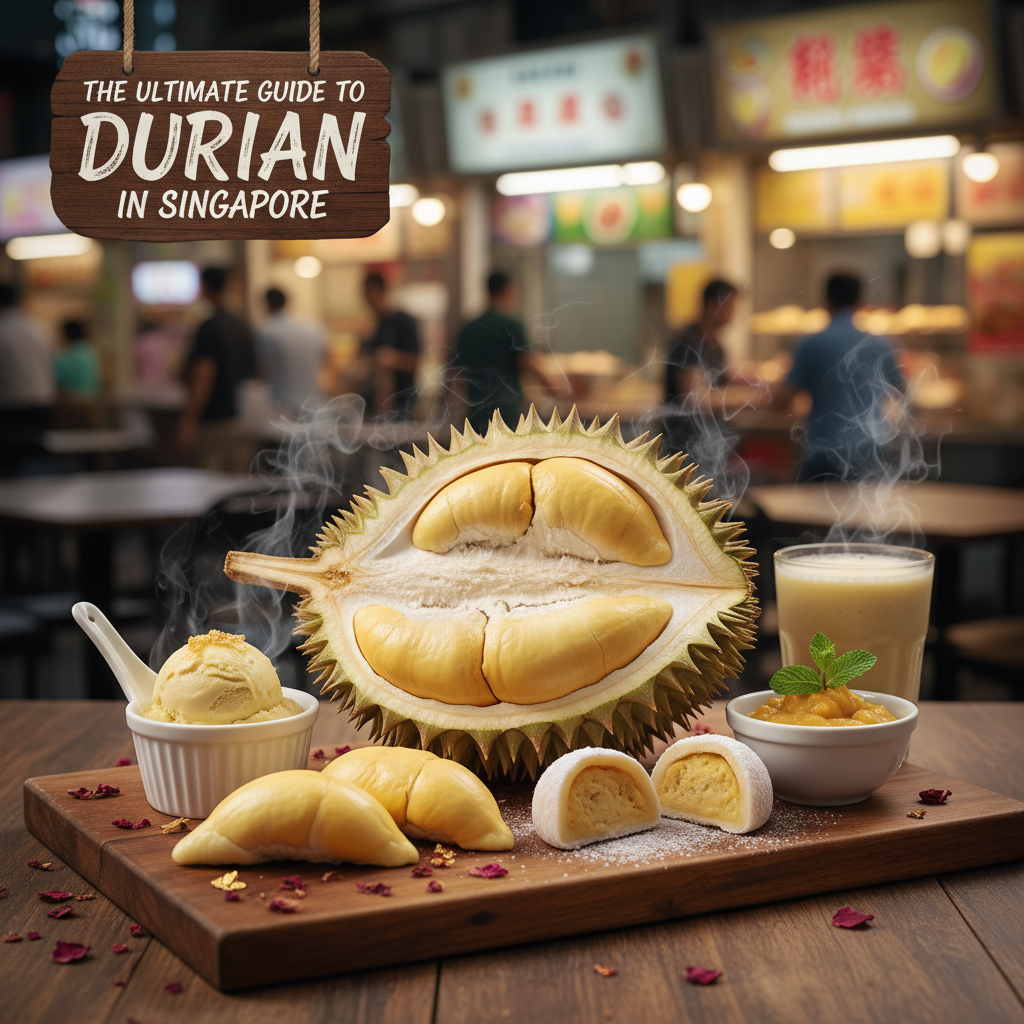
### Irresistible Durian Desserts: * **Durian Pengat:** A rich, creamy, and decadent traditional Malay dessert made by slowly cooking durian pulp with coconut milk and gula melaka (palm sugar). Often served warm or chilled. * **Durian Puffs:** Delicate choux pastry shells generously filled with smooth, fragrant durian cream. A bite-sized burst of durian heaven. * **Durian Chendol:** A refreshing iced dessert featuring pandan-flavoured jelly noodles, sweet red beans, coconut milk, gula melaka syrup, and a generous dollop of fresh durian pulp. * **Durian Ice Cream / Gelato:** Intense durian flavour, churned into a creamy, cold treat. Perfect for a hot Singapore day. * **Durian Mochi:** Soft, chewy Japanese mochi filled with luscious durian paste, offering a delightful textural contrast. * **Durian Cake / Crepe:** Various patisseries and cafes offer durian-infused cakes, crepes, and other pastries, from delicate durian mille crepe cakes to rich cheesecakes.
The Hunting Grounds: Where to Find Your Durian Fix
Singapore comes alive with durian during its season. Here's where to find the best:
### Dedicated Durian Stalls (Best for Fresh Durian): * **Geylang (Lorong 17, 21, 23):** This is the undisputed epicentre of durian in Singapore. You'll find a high concentration of reputable stalls here, especially during peak season. Must-visit names include: * **Ah Seng Durian:** (Ghaut Road, but often has stalls in Geylang too) – Known for quality and a wide selection. * **Combat Durian:** (Lorong 21 Geylang) – A long-standing favourite with a loyal following. * **Sindy Durian:** (Lorong 23 Geylang) – Another popular spot for fresh durians. * **Bukit Merah / Alexandra:** Areas like Bukit Merah Lane 1 are home to popular stalls like **99 Old Trees**, famous for MSW and other premium varieties, and an excellent dine-in experience. * **Other Areas:** Keep an eye out along major roads like MacPherson Road, Balestier Road, and even some hawker centres (e.g., Ang Mo Kio Ave 8) which host temporary durian stalls during the season. * **Roadside Pop-ups:** During peak season, temporary stalls pop up in almost every neighbourhood. Look for large displays of spiky fruit and bustling crowds.
### Dessert Shops & Cafes (For Durian Desserts): * **Goodwood Park Hotel Deli:** Famed for its annual Durian Fiesta, offering exquisite and premium durian pastries, cakes, and ice cream using top-grade durians. * **Four Seasons Durian:** Multiple outlets across Singapore, known for their durian puffs, cakes, and other durian-infused treats. Great for convenience. * **L.E. Cafe Confectionery & Pastry:** Famous for their traditional durian puffs and durian tarts. * **Many Local Bakeries & Hawker Centre Dessert Stalls:** Especially during peak season, you'll find independent bakeries and dessert stalls offering durian puffs, chendol, or other seasonal durian delights.
Navigating the Spikes: Ordering Tips & Etiquette
Approaching a durian stall can be intimidating for the uninitiated, but a few tips will make you feel like a seasoned pro:
1. **Communicate Your Preference:** Tell the vendor if you prefer sweet, bitter, creamy, or a mix. They are experts and will recommend based on your taste and budget. 2. **Ask for a 'Re-crack':** If the durian opened isn't to your satisfaction (e.g., not enough flesh, unripe, overripe), politely ask for another one. Reputable vendors will usually oblige without fuss. This is common practice. 3. **Gloves are Your Friend:** Most stalls provide plastic gloves. Use them to keep your hands clean and avoid the lingering smell. 4. **Eat with Your Hands:** While spoons are available for desserts, eating fresh durian with your hands is part of the authentic experience. Scooping the creamy flesh directly from the husk is deeply satisfying. 5. **Be Mindful of the Smell:** Durian's potent aroma is not universally loved. It's strictly forbidden on public transport (MRT, buses) and often in hotels, taxis, and air-conditioned shopping malls. If taking durian home, ask the vendor to double-wrap it in newspaper and plastic bags. 6. **Wash Your Hands Properly:** After eating, rub your hands with the inside of a durian husk, then wash with water. The husk contains properties that help neutralise the smell. Some stalls even provide a bucket of water with durian husk pieces for this purpose. 7. **It's a Communal Affair:** Durian is often enjoyed in groups, sharing different varieties and comparing notes.
Price Expectations: A Price for the King
Durian prices fluctuate significantly based on seasonality, variety, and supply from Malaysia. Generally, they are quoted per kilogram (kg) of the whole fruit.
* **Mao Shan Wang (MSW):** The most expensive. Expect to pay anywhere from **S$18-S$30/kg** during peak season (June-August) and **S$25-S$40+/kg** during off-peak or early season. A medium-sized MSW might cost S$40-S$80. * **D24 / XO / Red Prawn / Black Pearl:** These varieties are typically more affordable, ranging from **S$12-S$25/kg** during peak season. * **Other varieties (e.g., local Thai varieties):** Can be as low as **S$5-S$10/kg** during a glut. * **Pre-packed durian flesh:** Usually sold by weight or in trays. Prices vary but are generally higher per kg of flesh compared to buying a whole fruit. * **Durian Desserts:** A durian puff might cost **S$2-S$5**, a slice of durian cake **S$8-S$15**, and durian chendol around **S$5-S$8**, depending on the quality and amount of durian used.
**Best time to buy:** Peak season (typically June to August, with a smaller season around November to February) generally offers better prices due to higher supply. Prices can surge during festivals like Chinese New Year due to increased demand.
Common Mistakes to Avoid for a Smooth Durian Experience
Don't let these pitfalls spoil your durian adventure:
1. **Not asking for a re-crack:** As mentioned, if the first durian isn't up to par, don't suffer in silence. A good vendor wants you to be happy. 2. **Buying pre-packed durian without tasting or knowing the source:** While convenient, pre-packed durian can be a gamble unless from a trusted source. You can't assess its freshness or quality before buying. 3. **Eating too much too quickly:** Durian is 'heaty' in Traditional Chinese Medicine terms, and consuming excessive amounts can lead to a sore throat, mild feverish feeling, or stomach discomfort for some. Pace yourself! 4. **Ignoring 'No Durian' signs:** This is crucial. Carrying durian into prohibited areas (hotels, MRT, taxis, malls) can result in fines or inconvenience. Always ask your hotel if durian is allowed in your room. 5. **Drinking alcohol or carbonated drinks immediately after durian:** This is an old wives' tale, but many still avoid it. The belief is that it can cause discomfort or even be dangerous (though scientific evidence is scarce). Stick to water or coconut water instead. 6. **Being afraid to try:** The smell can be off-putting initially, but don't let it deter you. Many find the taste surprisingly delicious once they get past the aroma.
Insider Tips from a Singapore Foodie
Want to elevate your durian game? Here are some secrets from a local enthusiast:
* **Go during Peak Season (June-August):** This is when supply is highest, variety is widest, and prices are generally most reasonable. You'll get the freshest fruit. * **Look for Stalls with a Queue:** A queue, especially one with locals, is usually a good indicator of quality and value. * **Trust Your Senses (and the Vendor):** A good durian should have a distinct, slightly sweet aroma, not overwhelmingly pungent (which can indicate overripeness). Ask the vendor to tap the durian – a hollow sound suggests good flesh separation. Look for a relatively round shape and a dry stem. * **The Mangosteen Pairing:** In local tradition, mangosteens (the 'Queen of Fruits') are often eaten after durian. They are considered 'cooling' and are believed to balance the 'heatiness' of durian. * **Coconut Water is Your Best Friend:** It's refreshing, hydrating, and helps cleanse the palate and counteract any 'heaty' effects after a durian feast. * **Dealing with the Lingering Smell:** To neutralise durian smell in your car or home, place the durian husks in the footwell or near vents. The internal husk acts as a natural air purifier. You can also place used husks in a bin with water. * **Explore Different Varieties:** Don't just stick to MSW. Venture out and try XO, Black Pearl, Red Prawn, or even some lesser-known varieties. Each offers a unique flavour profile. * **Consider a Durian Buffet:** During peak season, some stalls offer all-you-can-eat durian buffets. These can be great value if you're a big eater and want to try various types. Enquire beforehand about the varieties offered.
Frequently Asked Questions (FAQs)
**Q: Is durian safe to eat?** A: Yes, absolutely! For most people, durian is a safe and delicious fruit. As with any food, moderation is key, especially given its richness and calorie content.
**Q: Why does durian smell so strong?** A: Durian's unique aroma comes from a complex mix of volatile sulfur compounds. These compounds are responsible for its distinctive, often polarising, fragrance.
**Q: What does 'heaty' mean in relation to durian?** A: 'Heaty' is a concept from Traditional Chinese Medicine (TCM), referring to foods that are believed to generate 'internal heat' in the body, potentially leading to symptoms like sore throat, mouth ulcers, or feverishness. While there's no Western scientific basis, many locals believe durian is 'heaty' and balance it with 'cooling' foods like mangosteen or coconut water.
**Q: How should I store leftover durian?** A: Remove the flesh from the seeds, place it in an airtight container, and store it in the refrigerator. It's best consumed within 1-2 days. For longer storage (up to a month or more), you can freeze the pulp in an airtight container.
**Q: What are the health benefits of durian?** A: Durian is surprisingly nutritious, packed with vitamins (like Vitamin C, B-complex), minerals (potassium, manganese), dietary fibre, and healthy fats. However, it is also high in calories and natural sugars, so consume it in moderation.
**Q: Can I take durian on a plane?** A: Most airlines strictly prohibit durian in both carry-on and checked luggage due to its strong odour, which can permeate the entire cabin or cargo hold. It's best to avoid bringing durian onto flights.
Conclusion: Embrace the Spike, Savor the Sweetness
There you have it – your comprehensive guide to navigating the thrilling, aromatic world of durian in Singapore. This thorny fruit is more than just a snack; it's a cultural icon, a conversation starter, and an experience that truly defines the adventurous spirit of Singaporean food. Don't let its formidable exterior or potent aroma deter you. Take the plunge, arm yourself with these tips, and trust me, you might just discover a new obsession. So, when the season calls, head out, embrace the spikes, and savour the unparalleled sweetness and complexity of the King of Fruits. Your Singapore culinary journey won't be complete without it! Happy durian feasting, my fellow food adventurers!